
The problem: “mysterious judges” in charge of billions

Prediction markets will not win the next trillion in volume if outcomes are decided by anonymous whales in Discord. They’ll win when every contract settles on cryptographic truth that anyone can verify. That’s exactly what TRUF.NETWORK plus Predict.truflation.com is built to deliver.
The recent Wall Street Journal article just highlighted how Polymarket disputes are ultimately decided by UMA token holders, often anonymous, often financially exposed to the very markets they’re “judging.” In nearly 20% of cases reviewed, the accounts deciding the outcome also had positions in the same market, a structural conflict of interest that only gets more tempting as volumes grow.
When the final result of a market can be swung by a concentrated voting bloc, the entire premise of “trustless” prediction markets starts to crack. You don’t just need to be right about the world, you also need to be right about how a handful of token holders will vote when the stakes get uncomfortable.
Why human voting doesn’t scale
Human-governed oracles made sense when prediction markets were small experiments. But as the industry marches toward tens of trillions in annual notional, the incentives to nudge, delay, or outright hijack outcomes grow exponentially. No matter how you dress it up. Optimistic oracles, dispute bonds, governance forums, if humans with money on the line are the final arbiter, you’ve hard‑coded moral hazard into your settlement layer.
At scale, “who decides the truth?” becomes the wrong question. The only question that matters is: “Can everyone independently verify the same truth, instantly, without trusting a committee?”
The TRUF.NETWORK answer: certified attestation
TRUF.NETWORK is built as a programmable truth layer, not another market or oracle brand. Instead of asking voters to interpret reality, it encodes markets as deterministic SQL queries over transparent data, and then enforces those results at the protocol level.
- When it’s time to settle, TRUF.NETWORK validators execute the query and cryptographically sign the result as a condition of block validity.
- Markets are defined by SQL queries that specify exactly how the outcome is computed from data.
- The output is a standardized attestation, a fixed-format object containing the SQL query, its computed result, and validator signatures, so any smart contract or blockchain can quickly verify that the outcome is valid and untampered.
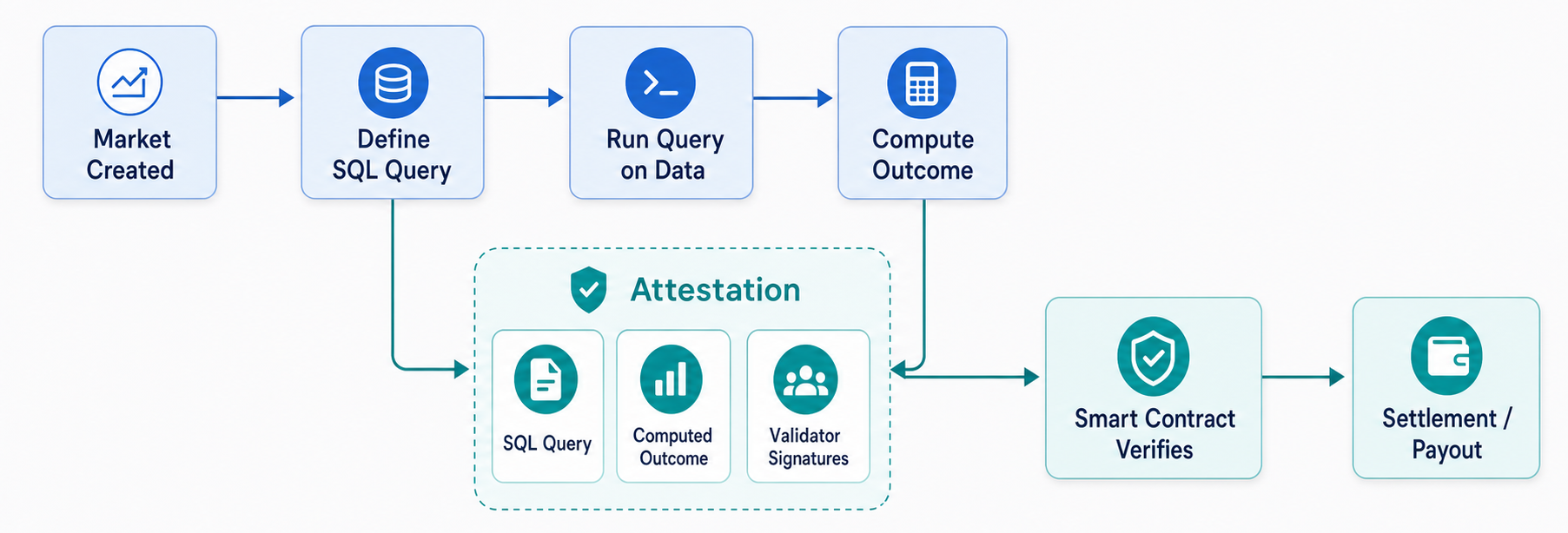
No Discord threads, no “judge” identity crisis, no guessing how a DAO feels about edge cases this week, just here is the data, here is the query, here is the proof.
Solving the Oracle Problem at the integrity layer
Traditional oracle networks like Chainlink focus on data delivery, moving a data point from off-chain to on-chain via decentralized oracle nodes. That’s necessary, but it doesn’t fully answer the hardest question for prediction markets: “How do I know this is the right data, computed the right way, at the right time?”
TRUF.NETWORK attacks that problem at the integrity layer:
- Programmatic settlement, zero human votes: Outcomes are computed directly from data via SQL, then sealed by validator signatures. There is no dispute window where humans can rewrite reality.
- Transparent provenance: Every attested datapoint carries an on-chain audit trail so you can inspect the “source of truth” even before launching a market:
- who provided the data
- when it was written and
- how it has been used
- Plug into existing stacks: TRUF Attestations are designed to be used as payloads inside existing oracle rails. A contract on Ethereum can use Chainlink for message delivery while requiring a TRUF-certified attestation as the condition for paying out.
You don’t have to rip out your infrastructure. You just stop asking humans to bless the scoreboard.
Accuracy through competition, not committees
The other half of the equation is how data gets into the system in the first place. TRUF.NETWORK is permissionless: anyone can add data or spin up a market’s order book for a few cents in $TRUF. That low friction creates an environment where accuracy emerges from competition instead of from an anointed “official” feed.
- Multiple providers can publish data for the same event or index
- Providers pay a small fee to write, then earn royalties in $TRUF and collateral rewards whenever their data is used in a certified attestation
- Over time, markets naturally route to the most accurate, most frequently used data streams, pushing out noisy or low‑quality feeds
By collapsing the cost of market and data creation, TRUF.NETWORK makes it viable to host the “long tail” of markets such as local economic readings, niche sports, micro‑events, that centralized platforms will never touch.
Where Predict.truflation.com comes in
If TRUF.NETWORK is the programmable truth layer, Predict.truflation.com is one of the first front-ends that lets traders actually bet on that truth.
- Truflation already powers real-time macro indexes used in live, regulated markets like Kalshi. Think daily-settled CPI, commodity baskets, and specialized inflation signals getting settled on markets and exchanges.
- Predict.truflation.com sits on top of that same independent data, letting users trade on inflation, macro, and real-world indicators with outcomes settled by cryptographic attestations rather than human votes.
- As TRUF.NETWORK rolls out more data sources and market templates, Predict becomes the orderbook UI for a global, chain-agnostic truth engine, where every contract references a verifiable, on-chain scoreboard instead of a governance forum.
For builders, this means you can launch markets that settle directly on TRUF attestations while routing liquidity through Predict or any other compatible UI. For traders, it means your edge is about being right in reality, not about gaming a dispute process.
From Polymarket to “Proof of TRUF”
Polymarket proved that the world wants to trade in the future. The WSJ proved that the current dispute infrastructure is nowhere near good enough for the scale that’s coming. The next generation of prediction markets won’t be won by better memes or slicker apps, but by one boring, essential thing: who has the most credible, independently verifiable truth layer under the hood.
TRUF.NETWORK is that layer. Predict.truflation.com is one of the first places you can trade directly on it. Together, they turn “mysterious judges” into obsolete relics and replaces them with something far more powerful: math.